Thursday, April 29, 2010

Animal Feed, Not Automobiles, Makes the San Joaquin Valley a Smog Hotspot


A new study identifies cattle feed as a possible culprit in the long-standing mystery of why California's San Joaquin Valley -- a moderately-populated agricultural region -- has higher levels of ozone (one of the main ingredients in smog) than many densely-populated cities. (Credit: iStockphoto/Jean Frooms)
A new study identifies cattle feed as a possible culprit in the long-standing mystery of why California's San Joaquin Valley -- a moderately-populated agricultural region -- has higher levels of ozone (one of the main ingredients in smog) than many densely-populated cities. 

The report, which explains how fermented cattle feed works with automotive exhausts in forming ozone, is in ACS' Environmental Science & Technology.

Michael Kleeman and colleagues note that high ozone levels in the San Joaquin Valley, which produces 10 percent of America's food, have puzzled scientists for years. 

Motor vehicles are the major source of smog elsewhere, but the Valley has fewer motor vehicles compared to big urban areas with similar levels of ozone. Suspicion thus fell on farming activities, and the new study investigated the role of fermented livestock feed.

The paper documents emissions of reactive organic gases, which react with combustion emissions and sunlight to form smog, from seven different animal feeds. It shows how fermented feed like silage appears to be the largest man-made source of these organic gases that contribute to ozone formation in the Valley even more than automobiles. The until-now-unrecognized animal-feed factor may account for the failure of traditional vehicle smog control regulations in the Valley, they note.

April 21, 2010
Source: ScienceDaily

Too Fat to Fight


Report by
Mission: Readiness, Military Leaders for Kids
Click here for full report.

Are Healthy Thinkers also Healthy Shoppers?

healthy-shopping [1]

Steve French, Managing Partner, Natural Marketing Institute &
Todd Hale, Senior Vice President, Consumer & Shopper Insights, The Nielsen Company

SUMMARY: Consumers recognize the connection between diet and health, and for the most part, act on that knowledge. Perhaps a by-product of their quest for wellness, health-aware consumers are careful with their bodies and their budgets, making fewer impulse buys, using shopping lists, savoring the shopping outing and efficiently walking the aisles with a connoisseurs’ knowledge of merchandising and planograms.

Americans have gotten the message loud and clear: a healthy diet is an essential element in any wellness program. Nielsen researchers found that people practice what they preach, with most shoppers buying foods that are good for the waistline and wallet.

Natural Marketing Institute [2] (NMI) conducts an annual health and wellness survey to determine what consumers consider healthy. Shopper insights showed consumer interest in minimally processed foods, a short list of recognizable label ingredients, less of the “bad stuff” like trans fats or MSG, and more of the “good stuff” like fiber, antioxidants, vitamins/minerals, calcium, Omega 3s, whole grains, heart-healthy ingredients and Vitamin D.

Healthy Segments
When it comes to health beliefs and practices, NMI found that people fit into one of five distinct segments that inform their shopping and buying decisions:

  • “WELL BEINGS”® (19%)—the most health-proactive group; market leaders and influencers whose actions are driven by values. They eat more organics, consume modest amounts of supplements and pursue many different health modalities.
  • “FOOD ACTIVES”® (18%)—more mainstream in their health pursuits, this group strives for moderation in their lifestyle and prefers food that is inherently healthy vs. organics or supplements. Seeking a life balance includes balancing the budget for this price-sensitive segment.
  • “MAGIC BULLETS“® (24%)—consumers who hope supplements, Rx and pills will help them reach health goals. More into health management than prevention. Least likely to cook at home or exercise.
  • “FENCE SITTERS”® (17%)—stressed out, but seeking control. They dabble in the latest exercise kick and actively pursue weight loss goals. Receptive to eco-friendly appeals and reliant on social media.
  • “EAT, DRINK & BE MERRYS”® (22%)—younger shoppers who crave taste and pinch pennies. No concerns here about prevention, making them the least health-active group.

Big Spenders
According to Nielsen, healthier segments (”WELL BEINGS,” “FOOD ACTIVES,” and “MAGIC BULLETS”) appear more thoughtful about food, beginning with the shopping experience. In addition to shopping more often online than less wellness-oriented groups, they log more shopping trips per household each year, spend more in total annually and have a tendency to buy more on deal.

HealthWellness_Chart1kz [3]

Preferred channels include grocery stores, which offer the widest variety of fresh and organic products; drug stores, where they can find a cure for what ails them plus supplements to round out their diet; and warehouse club stores known for outstanding value but limited offerings on the food and drug fronts. Health-oriented shoppers are least likely to patronize supercenters, mass merchandisers, convenience/gas stores and dollar stores.

Grocery spending patterns reflect an emphasis on formats that have made a name based on their produce and fresh departments, tasty samples, customer service and client education ranging from proprietary health labeling systems to in-store seminars and demonstrations.

Hidden Vices
Despite a commitment to health and wellness, the occasional indulgence sneaks in. Even health-aware shoppers like an alcoholic beverage now and then, with “WELL BEINGS” and “MAGIC BULLETS” outspending other segments at liquor stores.

While this quirk may be explained away by the cardiovascular benefits of red wine or simply a propensity to entertain, the penchant for smoking is puzzling (perhaps a vice of a spouse or other family member who is not as engaged in leading a healthy lifestyle). “FOOD ACTIVES” and “MAGIC BULLETS” trail only the “EAT, DRINK & BE MERRYS” in tobacco store spending.

Buying Right
Category spending patterns underscore the consistency between the health beliefs that define each segment and spending practices. The three most health-committed segments (”WELL BEINGS,” “FOOD ACTIVES” and “MAGIC BULLETS”) outspend others in categories with foods known for health properties including nuts, yogurt, fresh produce and vitamins.

HealthWellness_Chart2 [4]

Equally consistent with healthy attitudes, the three most health-aware groups under-spend relative to other segments in calorie-dense, lower-nutrient foods and beverages such as carbonated beverages, beer and frozen pizza and snacks.

Article printed from Nielsen Wire: http://blog.nielsen.com/nielsenwire


URL to article: http://blog.nielsen.com/nielsenwire/consumer/are-healthy-thinkers-also-healthy-shoppers/

“Food Politics:” A New Book Well Worth Reading

The Political Scientist, Robert Paarlberg (Wellsley, Harvard – Weatherhead Center for International Affairs) has just published a new book (Oxford University Press) titled, “Food Politics: What Everyone Needs to Know.” I would recommend it highly to anyone who cares about international food issues, sustainability and the like. It is a succinct, easy to read, but well-documented discussion of most of the important issues surrounding our food supply.

Paarlberg is a widely recognized expert on international food and trade issues who has spent a long and notable career focused on those topics. He not only bridges the disciplines of political science and economics, he is a self taught expert on agricultural issues and the realities of “small-holder” farming in the developing world. I’ve read his books and papers and listened to some of his lectures online. As an agricultural scientist, I have to say that I’m impressed with his depth of understanding of farming and agricultural technology.

An Independent Voice
My wife and I had the opportunity to sit down with Robert for lunch this January in Boston and learn what a warm and sincere person he is. He has a unique, independent voice in various food and technology debates. He writes the following about his sources of support over the last few decades: “I have never accepted corporate funding for any of my research.” Instead he has been supported by Wellesley, the Weatherhead Center, IFPRI, USAID, the Council on Foreign Relations, the Brookings Institution, and by the The Ford, Rockefeller and Gates Foundations.

A commenter on a previous post about Paarlberg’s work “charged” that he had consulted for Monsanto. If corporations like Monsanto are listening to people like Paarlberg, that can only be a good thing! They never “bought” his opinions about the food system, they are only seeking to learn from his perspective.

What Food Politics?
In this relatively short book (189 pages, small format) Paarlberg takes on a great many issues and questions:
  • population growth vs food production
  • the food “crisis” of 2008
  • chronic hunger vs famine
  • the controversy about the “Green Revolution”
  • food aid and food power
  • obesity
  • farm subsidies and trade barriers
  • environmental issues for agriculture
  • animal welfare issues
  • agribusiness consolidation issues
  • fast food
  • organic
  • local
  • food safety
  • genetic engineering, and
  • who really governs the world food supply.
Paarlberg is willing to take on problematic issues in terms of governmental farm policies and food industry marketing tactics. He is an articulate critic of our animal agriculture system and its extreme consolidation. He is also a critic of the role of certain environmental groups whose activism has denied even very basic and safe technology-development to some of the world’s poorest people.

Paarlberg is also a critic of many protectionist practices, and also attempted manipulative efforts via food trade and food aid policies.

I would never say that any one person could have the “full picture” on something as complex as the global food supply, but this book represents a huge contribution to our understanding of it. Of all of Paarlberg’s books, this is the one that I would most vigorously endorse for broad readership.

By Steve Savage
April 27th, 2010
http://redgreenandblue.org/2010/04/27/food-politics-a-new-book-well-worth-reading/

Organic, small farmers fret over FDA regulation

Organic, small farmers fret over FDA regulation

Organic, small farmers fret over FDA regulation

Tuesday, April 27, 2010

(04-27) 04:00 PDT Washington -- Small farmers in California who have led a national movement away from industrial agriculture face a looming crackdown on food safety that they say is geared to big corporate farms and will make it harder for them to survive.

The small growers, many of whom grow dozens of different kinds of vegetables and fruits, say the inherent benefits of their size, and their sensitivity to extra costs, are being ignored.

They are fighting to carve out a sanctuary in legislation that would bring farmers under the strict purview of the Food and Drug Administration, an agency more familiar with pharmaceuticals than food and local farms.

A bill before the Senate is riding a bipartisan groundswell created by recent outbreaks of E. coli, salmonella and other contamination in everything from fresh spinach to cookie dough.

And the small farmers face opponents in consumer groups, victims of food contamination, large growers and the Obama administration, who say no farm and no food should get a pass on safety.

An even tougher version of the legislation passed the House last summer. Now, a behind-the-scenes battle is raging in the Senate over how to regulate small and organic growers without ruining them - and still protect consumers.

If two versions of the overhaul pass, Congress would work to merge them.

The legislation would mandate a range of programs intended to bolster food safety. The FDA would gain greater authority to regulate how products are grown, stored, transported, inspected, traced from farm to table and recalled when needed.

inpointing problems

But biologically diverse and organic growers argue that the problems that have plagued the food industry lie elsewhere.

They point to the sale of bagged vegetables, cut fruit and other processed food in which vast quantities of produce from different farms are mixed, sealed in containers and shipped long distances, creating a host for harmful bacteria.

The legislation does not address what some experts suspect is the source of E. coli contamination: the large, confined animal feeding operations that are breeding grounds for E. coli and are regulated by the U.S. Department of Agriculture, not the FDA.

"It does not take on the industrial animal industry and the abuses going on," said Tom Willey of T&D Willey Farms in Madera, an organic grower of Mediterranean vegetables. "The really dangerous organisms we're dealing with out here, and trying to protect our produce and other foodstuffs from, are coming out the rear end of domestic animals."

No one in Congress or the administration has yielded in a bureaucratic turf battle between the Department of Agriculture, which regulates meat, poultry and eggs, and the FDA, which regulates all other food.

The controversy began with the spinach E. coli outbreak near San Juan Bautista in 2006 that left four people dead, 35 people with acute kidney failure and 103 hospitalized. The bacteria, known as E. coli O157:H7, first appeared in hamburger meat in the early 1980s and migrated to produce, mainly lettuce and other leafy greens that are cut, mixed and bagged for the convenience of shoppers.

ontamination

Since then, there have been dozens of contamination cases, leading Congress to rewrite food safety laws by giving much more power to the FDA. But small growers worry that they, and consumers, will suffer in the sweep of reform.

"How do we trust that the FDA is going to know about things that the San Francisco Bay Area has been very progressive on - the field to fork, fresh, grow local, buy local - all of that?" said Rep. Sam Farr, D-Carmel. "The organic people are feeling that the regulations the FDA may promulgate will be so safety oriented, it'll put them out of business."

Consumer groups say they care about small farmers but that safety comes first.

"Our principle is that food should be safe, whatever the source," said Sandra Eskin, director of the Pew Health Group's food safety campaign, one of the Pew Charitable Trusts, which Monday sponsored a public meeting on the issue with federal officials in Seaside (Monterey County).

"People care profoundly about all these issues: feeding their families, food safety, local agriculture," Eskin said. "It's a passionate discussion and understandably so. Everybody eats."

Tom Nassif, head of Western Growers, which represents large produce growers, said small growers should not be exempt.

"If the small guy who sells to a farmers' market gets a family sick, it's a blip on the radar screen," Nassif said. "There's not a big hue and cry, because it didn't affect hundreds of people. What about those people? Doesn't their food safety count?"

rotocols

The tension that has come with food safety reforms was on display after the spinach outbreak rocked California. Large growers embraced costly science-based safety protocols for all leafy greens - guidelines that federal regulators are considering taking nationwide.

However, a UC Davis study last year by Shermain Hardesty and Yoko Kusunose found that the rules have put smaller growers at a disadvantage because their compliance costs are spread over fewer acres. Hardesty said costs may be as high as $100 an acre.

Large produce buyers such as Wal-Mart and McDonald's have gone much further than the industry standards. They have imposed rules of their own that have forced many California farmers who supply them to fence off waterways, poison wildlife to keep animals out of fields and destroy crop hedgerows that support beneficial insects.

Deputy Agriculture Secretary Kathleen Merrigan said Monday the administration is keeping a "close watch" on these so-called "super metrics," acknowledging that they have harmed the environment but said, "nobody gets a pass on food safety."

ncreasing the danger

Willey, the Madera farmer, argued that many food safety rules tend "to push us to embrace a paradigm of sterility," which, in the long run, increases the danger.

"When you create microbial vacuums, they can be even more easily taken over by pathogenic organisms," he said. "In organic agriculture, we depend tremendously on a cooperative effort with beneficial microorganisms. My whole soil fertility system is based on that. Actually, soil fertility planetwide is based on that."

Efforts to modify proposed rules to make compliance easier for biologically diversified farms have been more successful in the Senate than in the House. New language that requires the FDA to consider farm size, crop diversity, organic requirements and other issues has been added.

"While none of these things in themselves solves the cause for concern, they certainly point strongly in the direction of the FDA needing to take into account these considerations," said Ferd Hoefner, policy director for the National Sustainable Agriculture Coalition.

Hoefner called the House bill a one-size-fits-all approach that would be a "complete disaster" for small farms.

E-mail Carolyn Lochhead at clochhead@sfchronicle.com.

http://sfgate.com/cgi-bin/article.cgi?f=/c/a/2010/04/27/MNKM1D3C5H.DTL

A Ban on Toys With Fast-Food Meals for Children - NYTimes.com

A Ban on Toys With Fast-Food Meals for Children - NYTimes.com

Citing Obesity of Children, County Bans Fast-Food Toys

SAN FRANCISCO — It was not a happy day for the Happy Meal.

In what it described as a blow against the fattening temptations of fast food, the board of supervisors in Santa Clara County, south of San Francisco, voted Tuesday to ban the promotional toys that often accompany child-size portions of cheeseburgers and chicken nuggets if those meals don’t meet certain nutritional standards.

The criteria, which are based on federal standards and recommendations from the nonprofit Institute of Medicine, would apply to all fast-food restaurants giving away toys in meals in-tended for children. Ken Yeager, the board president, said the new law would level “the playing field by taking away the incentive to choose fatty, sugary foods over healthier options.”

“What we’re trying to do is de-link the connection between unhealthy food and toys,” said Mr. Yeager, who added that he believed children chose their meals based on the giveaway that came with it. “Why would a kid say ‘I want a burger with fries’? It’s the toys that they want.”

The law, the first of its kind, will allow restaurants to give away toys as long as the meals don’t contain excessive calories, sodium, sugar or fat. “This ordinance does not attack toys,” Mr. Yeager said just before the board passed the law by a 3-2 vote. “Toys, in and of themselves, do not make children obese.”

One of four children in Santa Clara is obese, with even higher rates among low-income residents, a target audience for the various cheap meals that fast-food restaurants offer. Obesity is also a big problem nationwide. Two-thirds of adults 20 years and over are overweight or obese, according to the National Center for Health Statistics. Numbers for children and adolescents are much lower, however, ranging from 11 to 18 percent.

Mr. Yeager, who does not have children, said the law would take effect this summer after a final vote in May.

Walt Riker, a spokesman for McDonald’s, said it was disappointed by the board’s action, adding that “our Happy Meals provide many of the important nutrients that children need,” including zinc, iron and calcium.


Supreme Court Hears Arguments on Genetically Modified Seeds

Food Democracy Now

Supreme Court Hears Arguments on Genetically Modified Seeds


By P.J. Huffstutter

The battle over genetically modified crops is being waged before the U.S. Supreme Court -- the first time the nation’s highest court is specifically weighing in on genetically modified organisms and the federal approval process that allows them to roll out from the laboratory to the nation’s farm fields.

The fight is between seed giant Monsanto Co. and Geertson Seed Farm, a far smaller Idaho-based rival, and the case revolves around whether Monsanto should be prevented from selling its genetically engineered Roundup Ready alfalfa seeds.

The biotech behind the seeds was reviewed by the U.S. Food and Drug Administration, and later approved by the U.S. Department of Agriculture prior to the company’s product launch in 2005.

Geertson has argued that such seeds should not be allowed to be sold, because of concerns that they can cross-contaminate nearby fields planted with organically produced alfalfa. They also argue that because these GMO seeds have been engineered to resist a commonly used herbicide that Monsanto makes, killing off such unwanted plants would be extremely difficult.

Monsanto argues that such fears are far-fetched and that such cross-pollination is unlikely. Instead, the company contends that using its seeds helps the environment because farmers don’t have to use as much weed killer on their fields. (Monsanto said in court filings that alfalfa, which is used to feed livestock, is grown on about 22 million acres across the nation.)

In addition, “the plaintiffs in the case have not demonstrated that continued planting of the crop was likely to cause irreparable harm to other alfalfa growers,” the company said in a statement posted on its website Tuesday. (The italics were an emphasis that Monsanto used.)

A lower court sided with Geertson and, since 2007, Monsanto has been barred from selling these seeds nationwide. So the issue now before the Supreme Court is whether the lower court had the authority to order such a far-reaching ruling under theNational Environmental Policy Act.

Both sides faced off before the court on Tuesday. A ruling is expected later in the year.

But here’s the real question that farmers and environmentalist are asking: Considering the USDA is slated to wrap up an environmental study on this and other issues next year, and the agency reportedly is expected to approve sales of such seeds, will the court’s ruling matter in the long run?

Originally published in The Los Angeles Times

Tuesday, April 27, 2010

Carbs against Cardio: More Evidence that Refined Carbohydrates, not Fats, Threaten the Heart: Scientific American

Carbs against Cardio: More Evidence that Refined Carbohydrates, not Fats, Threaten the Heart: Scientific American

Carbs against Cardio: More Evidence that Refined Carbohydrates, not Fats, Threaten the Heart

Whether the new thinking will be reflected in this year's revision of the federal dietary guidelines remains unclear

By Melinda Wenner Moyer

DONUT DEFEAT: This year U.S. dietary guidelines may target refined carbohydrates, which increase the risk for cardiovascular disease.


Eat less saturated fat: that has been the take-home message from the U.S. government for the past 30 years. But while Americans have dutifully reduced the percentage of daily calories from saturated fat since 1970, the obesity rate during that time has more than doubled, diabetes has tripled, and heart disease is still the country’s biggest killer. Now a spate of new research, including a meta-analysis of nearly two dozen studies, suggests a reason why: investigators may have picked the wrong culprit. Processed carbohydrates, which many Americans eat today in place of fat, may increase the risk of obesity, diabetes and heart disease more than fat does—a finding that has serious implications for new dietary guidelines expected this year.

In March the American Journal of Clinical Nutrition published a meta-analysis—which combines data from several studies—that compared the reported daily food intake of nearly 350,000 people against their risk of developing cardiovascular disease over a period of five to 23 years. The analysis, overseen by Ronald M. Krauss, director of atherosclerosis research at the Children’s Hospital Oakland Research Institute, found no association between the amount of saturated fat consumed and the risk of heart disease.

The finding joins other conclusions of the past few years that run counter to the conventional wisdom that saturated fat is bad for the heart because it increases total cholesterol levels. That idea is “based in large measure on extrapolations, which are not supported by the data,” Krauss says.

One problem with the old logic is that “total cholesterol is not a great predictor of risk,” says Meir Stampfer, a professor of nutrition and epidemiology at the Harvard School of Public Health. Although saturated fat boosts blood levels of “bad” LDL cholesterol, it also increases “good” HDL cholesterol. In 2008 Stampfer co-authored a study in the New England Journal of Medicine that followed 322 moderately obese individuals for two years as they adopted one of three diets: a low-fat, calorie-restricted diet based on American Heart Association guidelines; a Mediterranean, restricted-calorie diet rich in vegetables and low in red meat; and a low-carbohydrate, nonrestricted-calorie diet. Although the subjects on the low-carb diet ate the most saturated fat, they ended up with the healthiest ratio of HDL to LDL cholesterol and lost twice as much weight as their low-fat-eating counterparts.

Stampfer’s findings do not merely suggest that saturated fats are not so bad; they indicate that carbohydrates could be worse. A 1997 study he co-authored in the Journal of the American Medical Association evaluated 65,000 women and found that the quintile of women who ate the most easily digestible and readily absorbed carbohydrates—that is, those with the highest glycemic index—were 47 percent more likely to acquire type 2 diabetes than those in the quintile with the lowest average glycemic-index score. (The amount of fat the women ate did not affect diabetes risk.) And a 2007 Dutch study of 15,000 women published in the Journal of the American College of Cardiology found that women who were overweight and in the quartile that consumed meals with the highest average glycemic load, a metric that incorporates portion size, were 79 percent more likely to develop coronary vascular disease than overweight women in the lowest quartile. These trends may be explained in part by the yo-yo effects that high glycemic-index carbohydrates have on blood glucose, which can stimulate fat production and inflammation, increase overall caloric intake and lower insulin sensitivity, says David Ludwig, director of the obesity program at Children’s Hospital Boston.

Will the more recent thinking on fats and carbs be reflected in the 2010 federal Dietary Guidelines for Americans, updated once every five years? It depends on the strength of the evidence, explains Robert C. Post, deputy director of the U.S. Department of Agriculture’s Center for Nutrition Policy and Promotion. Findings that “have less support are put on the list of things to do with regard to more research.” Right now, Post explains, the agency’s main message to Americans is to limit overall calorie intake, irrespective of the source. “We’re finding that messages to consumers need to be short and simple and to the point,” he says. Another issue facing regulatory agencies, notes Harvard’s Stampfer, is that “the sugared beverage industry is lobbying very hard and trying to cast doubt on all these studies.”

Nobody is advocating that people start gorging themselves on saturated fats, tempting as that may sound. Some monounsaturated and polyunsaturated fats, such as those found in fish and olive oil, can protect against heart disease. What is more, some high-fiber carbohydrates are unquestionably good for the body. But saturated fats may ultimately be neutral compared with processed carbs and sugars such as those found in cereals, breads, pasta and cookies.

“If you reduce saturated fat and replace it with high glycemic-index carbohydrates, you may not only not get benefits—you might actually produce harm,” Ludwig argues. The next time you eat a piece of buttered toast, he says, consider that “butter is actually the more healthful component.”

Bridging the Evidence Gap in Obesity Prevention: A Framework to Inform Decision Making

April 23, 2010

Running Time: 00:58:04
Format: RealAudio (Requires free RealPlayer)

To battle the obesity epidemic in America, health care professionals and policymakers need relevant, useful data on the effectiveness of obesity prevention policies and programs. A new report from the Institute of Medicine identifies a new approach to decision making and research that uses a systems perspective to gain a broader understanding of the context of obesity and the many factors that influence it.

Related Resources:


Speakers:
Shiriki Kumanyika (Committee Chair), Christina Economos, Lawrence W. Green, Robert A. Hiatt, Adolfo M. Valadez

16 companies say they will reduce salt

16 companies say they will reduce salt

by Marion Nestle

New York City Mayor Michael Bloomberg announced yesterday that sixteen food companies have agreed to join the National Salt Reduction Initiativespearheaded by the city’s health department. The companies have volunteered to reduce the sodium in their products by 25% within the next five years. Mostly, they say they will do this by 2012 or 2014 (see summary table).

Nation’s Restaurant News points out that four of these companies are restaurant chains – Starbucks, Au Bon Pain, Subway, and Uno Chicago Grill. One, Boars Head, is a deli chain. And some food product companies – Mars, for example - are issuing their own press releases.

This is all good news and should encourage many more companies to take the low-salt pledge.

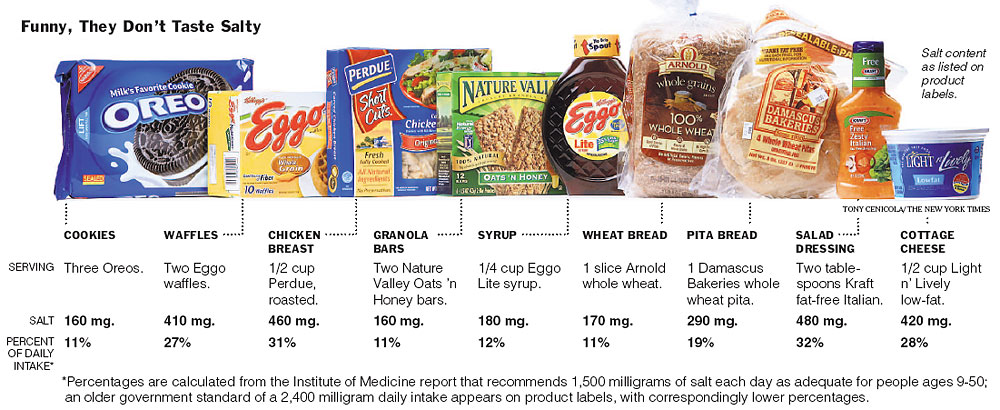
As the New York Times points out, salt lurks in unexpected places in processed foods. The article came with a great graphic, well worth a look.

To translate the numbers, recall that salt is 40% sodium. This means that 400 mg sodium = one gram of salt, 200 mg sodium = half a gram of salt, and 4 grams of salt = 1 teaspoon.

How Obama Sold the Farm

estabrook_recess_saulloeb_afpgetty_4-01_post.jpgThe Obama administration's schizophrenic approach to agriculture policy—making PR gestures toward sustainable farming with one hand while nudging ahead the agendas of agribusiness giants like Monsanto and Dow Chemical with the other—was on full display this weekend when the President used a recess appointment to install Islam Siddiqui as the chief agricultural negotiator in the Office of the United States Trade Representative.

"He was a singularly poor choice," said Dr. Marcia Ishii-Eiteman, senior scientist with the
Pesticide Action Network North America. "He is the wrong person with the wrong background. We are surprised and very disappointed that President Obama recess-appointed him. There should have been a full Senate vote."

It's telling that Obama used the same cynical, behind-the-scenes tactic to secure the Siddiqui appointment that his predecessor used to place judges like Charles Pickering (blocked because of past decisions that some considered racist) on the federal bench.

Prior to his appointment, Siddiqui was a vice president and lobbyist for
CropLife America, a trade organization representing major corporate players in the agricultural chemical industry. CropLife became known to the public when it berated Michelle Obama for putting in a (horrors!) organic kitchen garden at the White House.

"The garden is a great idea and the photo op of the First Lady and the local elementary school children digging up the ground was precious, but did you realize that it will be an organic garden?" the industry group wrote during Siddiqui's tenure, in a plea to supporters to launch a pro-pesticide letter writing campaign. "What message does that send to the non-farming public about an important and integral part of growing safe and abundant crops to feed and clothe the world—crop protection products."

It was part of a career-long pattern of Siddiqui being on the wrong side of sustainable agriculture issues. He played a key role in drafting language (eventually rejected) that would have allowed genetically modified crops, crops treated with human sewage sludge, and crops exposed to irradiation to be considered organic under United States Department of Agriculture (USDA) standards. In 1999, while at the USDA, he fought against consumer labeling of genetically modified foods, saying it would lead to increased food costs.

His nomination was expected to sail through the confirmation process when announced late last year. But it stalled when over 90,000 individuals and nearly 100 consumer advocacy groups representing farmers, environmentalists, religious organizations, and labor rights activists rose up to express their objections.

"At CropLife, Siddiqui was all about promoting genetic crops and pesticides," Ishii-Eiteman said. "When word got out that he had been nominated, it hit a nerve with the public."

Given that Siddiqui's employer also chose to diss the First Lady's horticultural philosophy, it might have hit a nerve a little closer to home for the President. As Ishii-Eiteman put it, "You have to wonder what kind of dinner conversations they had."
 
By Barry Estabrook
April 1, 2010

Monday, April 26, 2010

Snack Attack


Marketers are tripping over each other to prove their concern for kids’ health. Will the public buy it?

April 25, 2010


“Obesity causes a conflict of interest for food manufacturers,” she adds. “On the one hand, they need to please stockholders. ... On the other, they need to appear to be doing something about obesity. ... That’s a dilemma not easily resolved.”

One thing is clear: Companies that don’t stay ahead of the debate could lose the support of consumers and the patience of policymakers.

Consumer watchdog group Corporate Accountability International -- the folks who sent Joe Camel packing in the ’90s -- is now calling for the head of fast food’s most celebrated mascot, Ronald McDonald. (McDonald’s has publicly stated that Ronald is not used to directly promote food in advertising or in personal appearances.) Also, the country’s new healthcare law requires chain restaurants to post the calorie counts of their menu items, and the U.S. Food and Drug Administration has begun taking aim at misleading front-of-package food labels.

But even critics understand the complicated nature of wanting to help solve the obesity epidemic by making changes in how companies market to kids. “Changing advertising might help move us in the right direction, but it’s obviously only one factor,” says the University of Illinois’ Powell. “We need to make changes in all facets of life and this is one of them. ... No one should actually be thinking [advertisers are] solely to blame. We didn’t get here because of one single thing. It’s many forces working simultaneously."

Kolish, of the CFBAI, says from their perspective, marketers’ progress has been substantial: “I’m not saying there isn’t more work to be done,” she notes. “But we knew that consumer-package companies weren’t going to become green grocers overnight.”
Advocacy groups and parents also want to see changes made to the ingredients put into kids’ food. Since the establishment of the CFBAI, participating companies have reformulated or created more than 100 food or beverage products to meet self-imposed improved nutritional standards, says Kolish, as well as freshened up offerings, such as the apple slices in McDonald’s and Burger King’s kids’ meals.
More ...

Why We Need to Limit Salt in Packaged Foods

Michael F. Jacobson: Why We Need to Limit Salt in Packaged Foods

Why We Need to Limit Salt in Packaged Foods

I love black beans generally and black bean soup in particular. Filling and inexpensive, beans are high in dietary fiber, low in unhealthful fats, and hospitable to garlic, onion, red pepper, and spices. If you were having lunch at a restaurant, black bean soup could be the healthiest thing on the menu.

Or, it could be a bowl of stroke du jour.

If you're at all skeptical of whether the federal government should regulate the amount of sodium in processed or restaurant food, consider Chili's. A bowl of black bean soup at Chili's contains 1,480 milligrams of sodium. For fully 70 percent of the adult population-- including those of us over 40, African-Americans, and people with high blood pressure--that's basically all the sodium they should eat in an entire day.

Chili's Jalapeno Smokehouse Burger, with Jalapeno Ranch dressing and a side of fries, certainly doesn't have the same kind of healthy halo that black bean soup has. Everyone knows that plate will have too many calories and too much saturated fat. But seriously: Would anyone expect a burger and fries to have 6,460 mg of sodium, or more than four days' worth?

A weekly meal of that sort at Chili's--plus similar horror stories at restaurants or at home-- is likely to set even healthy people on the path to hypertension. And for an elderly person, a meal with thousands of milligrams of sodium could be enough to trigger congestive heart failure.

Chains like Chili's are basically vandalizing the food supply.

Happily, a long-awaited report from the Institute of Medicine has alighted on the desks of top officials at the Food and Drug Administration and the U.S. Department of Agriculture. Ordered up by Congress at the behest of Senator Tom Harkin (D-IA) and Representative Rosa DeLauro (D-CT), the report confirmed what many in the medical community have been saying for years: Americans are eating too much salt, which raises blood pressure and promotes heart disease, stroke, and other ailments. And the first recommendation made by the IOM is that the FDA "expeditiously initiate a process to set mandatory standards"--in other words, limits--"for the sodium content of foods."

Limiting salt in packaged and restaurant foods is perhaps the single most important dietary improvement that the Food and Drug Administration could bring about. Cutting sodium levels in packaged and restaurant foods in half is predicted to save 100,000 lives and tens of billions of dollars in health-care expenses each year.

The IOM recommends that reductions be phased in stepwise, giving Americans' palates, now accustomed to overly salty foods, a chance to readjust to safely seasoned foods. Though an unnamed FDA source speculated that such a transition could take 10 years, some foods have two or three times as much as competing products, suggesting that there's a lot of low-hanging fruit that should permit faster action.

In anticipation of the IOM report, companies such as Kraft, Campbell's, General Mills, and PepsiCo have all issued press releases in recent months indicating that they will take steps to reduce the sodium in their products by various percentages. I'm glad they're doing that. And I hope more companies follow suit, particularly restaurant chains. But it won't be enough. As the IOM report unambiguously points out, 40 years of voluntary action by manufacturers and restaurants to reduce salt intake has been a dismal failure.

As if on cue, the Salt Institute, the industry trade association, said that reductions would be "immoral," based on poor science, and that high-sodium diets actually benefit some people. And the Tea Party crowd huffed that the prospect of limits on salt is "the nanny state gone wild." But those of us who really care about culinary liberty know that limits on salt actually restore power to consumers, who could be set free to add as much or as little salt to their black bean soup as they want.

Thursday, April 22, 2010

Portland: Farm-Fresh Food [Fast Cities 2010]

Portland: Farm-Fresh Food [Fast Cities 2010]

http://www.fastcompany.com/magazine/145/fast-cities-farm-fresh-food-portland.html

By: Kate Rockwood May 1, 2010 Cities-87-Portland-1

Portland has long been lauded for its farmers markets, but in February, the city welcomed a new high-tech tool to bring large-scale, farm-fresh foods to city hospitals, public schools, corporate cafeterias -- even Oregon state prisons. Think of FoodHub as the Match.com for the locavore movement. Wholesale food buyers log on to access thousands of small and regional producers, as well as info on varietals sold, minimum orders, insurance, and delivery options. Launched by environmental not-for-profit Ecotrust, FoodHub has already signed on hundreds of Portland restaurants, grocery stores, and businesses and expanded to neighboring states. In March, it registered 32 of Bon Appétit Management's food service accounts, including Adidas, Amazon, Nordstrom, and the Seattle Art Museum. "This is not a tool for the precious," says Deborah Kane, Ecotrust's VP of food and farms. "It's showing people committed to strengthening the local food community what's out there."

Risks for Youths Who Eat What They Watch - NYTimes.com

Personal Health - Risks for Youths Who Eat What They Watch - NYTimes.com


Many factors influence children’s food choices: where they eat; what their friends and siblings eat; what parents eat and drink and bring into the house; what is served at school; and, of course, what they like.
But if you are a parent, would you want your children’s food and beverage choices determined by manufacturers whose primary goal is to make money by getting them hooked on products of questionable nutritional value? The issue is of particular importance now that rates of childhood obesity are soaring throughout the country, influenced in no small way by commercial interests.
Too Much Sugar on TV...
Last month, the Center for Science in the Public Interest, a Washington-based advocacy group, gave a grade of F to 95 of 128 food and entertainment companies for their policies — or lack thereof — on marketing to children. This despite the Children’s Food and Beverage Advertising Initiative started in 2006 by the Better Business Bureau, in which 16 major food and restaurant companies, representing about 80 percent of television food advertising expenditures, announced they would not market foods to children under 12 if they did not meet the companies’ own nutritional standards.
Unfortunately, there’s the rub. What a company like Kellogg’s regards as an acceptable amount of sugar in a serving of breakfast cereal may not be what a nutrition-wise parent would choose. The cutoff adopted by Kellogg’s is 12 grams (3 teaspoons of sugar), which would keep them from promoting Cocoa Krispies (14 grams of sugar in a one-cup serving) to children. But Frosted Flakes, with 11 grams, could still be advertised in venues where children 6 and older will see them. (The company does not aim advertising at children under 6.)
Also, since each company sets its own guidelines, what applies to Kellogg’s might not apply to products made by General Mills or Post.
“Despite the industry’s self-regulatory system, the vast majority of food and entertainment companies have no protections in place for children,” said Margo G. Wootan, the center’s nutrition policy director. In the center’s analysis of marketing to children, released last November, the highest grade, a B-plus, went to the candy maker Mars, which does not market to children under 12 and avoids other gimmicks that attract them.
“If companies were marketing bananas and broccoli, we wouldn’t be concerned,” Dr. Wootan said. “But instead, most marketing is for sugary cereals, fast food, snack foods and candy. And this junk-food marketing is a major contributor to childhood obesity.”
Furthermore, the analysis showed, although 64 percent of food companies that advertise to children at least have some sort of marketing policy, only 24 percent of restaurants and 22 percent of entertainment companies have any policy guiding advertising to children.
In a study released in March 2007, the Henry J. Kaiser Family Foundation noted that children ages 2 to 7 see an average of 12 televised food ads a day, or 4,400 a year, and children 8 to 12 see an average of 21 a day — more than 7,600 a year. For teenagers, the numbers are 17 a day, or more than 6,000 a year. Fully half of all ad time on children’s shows is for food, the foundation reported.
“Most of the food ads that children and teens see on TV are for foods that nutritionists, watchdog groups and government agencies argue should be consumed either in moderation, occasionally or in small portions,” the group found. “Of the 8,854 food ads reviewed in the study, there were no ads for fruits or vegetables targeted at children or teens.”
In case you are wondering, several studies have demonstrated that television ads do indeed have an effect — and not a good effect — on what children eat, and how much.In one study of 548 students at five public schools near Boston, published in 2006 in The Archives of Pediatric and Adolescent Medicine, researchers found that for each additional hour of television viewing, the children consumed an additional 167 calories, especially the calorie-dense, low-nutrient foods frequently advertised on television.
...and at the Movies
Now, a new study suggests, it’s time to attend to more subtle promotions of questionable foods, beverages and eating establishments that appear in movies popular among children and adolescents. “Movies,” the authors stated, “are a potent source of advertising to children, which has been largely overlooked.”
The study, published in March in the journal Pediatrics, analyzed brand placements for foods, beverages and eateries depicted in the top 20 box-office hits for each year from 1996 to 2005. Of the 138 movies analyzed, 49 percent were rated PG-13, 20.5 percent were PG and 7.5 percent were G.
“We found that a surprising proportion of movies that were targeted to children and adolescents featured brand appearances,” the authors wrote. Although Coca-Cola and Pepsi have long-standing commitments not to advertise their products on children’s television, the researchers found that “sugar-sweetened beverage products from these companies regularly appeared in movies, especially those rated for children and adolescents.”
Of the 1,180 brand placements identified, 26 percent of the food placements were for candy and other confections and 21 percent for salty snacks; 76 percent of the beverages were sugar-sweetened drinks, and two-thirds of the restaurants were fast-food places. The researchers found that “soft drinks, chips and fast-food brands dominated PG-rated and PG-13-rated movies.”
The authors, led by Lisa A. Sutherland of Dartmouth Medical Center, found an average of 8.6 brand placements per movie, and concluded that most were “for energy-dense, nutrient-poor foods or product lines.”
An Insidious Effect
Lest you doubt these brand placements influence young eating habits, the appearance of Reese’s Pieces in the movie “E.T. the Extra-Terrestrial” resulted in a sharp increase in sales in the three months after the movie’s release in 1982.
“Movie product placement is on a par with subliminal advertising, yet it has been largely ignored by those who study the impact of marketing on children,” the authors wrote.
The authors expressed particular concern about the influence of brand placements in movies rated PG and PG-13 on older children and teenagers, “who are gaining independence with respect to their food choices.” They noted that this “provides a likely avenue by which brand loyalty and product preference can be built.”
What can you do? I wouldn’t dare suggest passing up a wonderful movie like “E.T.” But just as parents and others have objected to sugary drinks sold in schools and, to a lesser effect so far, to foods advertised on children’s television, it may be time to make your feelings known to movie producers about how brand placements are harming the health and increasing the weight of America’s children.