Thursday, January 24, 2013

New study: Big Food's ties to Registered Dietitians

Jan 22 2013

New study: Big Food’s ties to Registered Dietitians

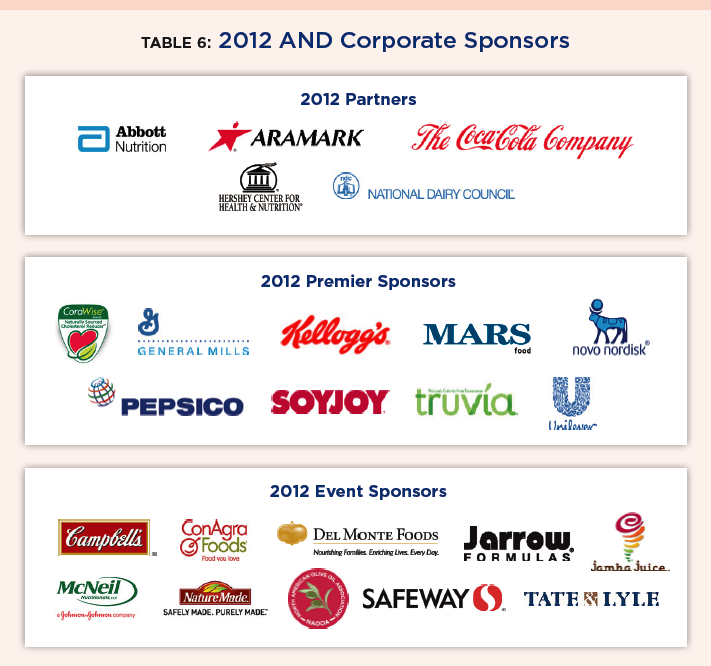
Michele Simon, president of Eat, Drink, Politics, an industry watchdog consulting group, has just published an exposé of the close financial relationships between food and beverage companies and the Academy of Nutrition and Dietetics (AND, formerly the American Dietetic Association).

Her hard-hitting report, And Now a Word from Our Sponsors: Are America’s Nutrition Professionals in the Pocket of Big Food? provides ample evidence that partnerships and alliances with Big Food make it impossible for AND members to convey clear and accurate messages about nutrition and health.

When she talks about nutrition professionals, she doesn’t mean me.  I have a PhD (in molecular biology, although long lapsed) and a master’s in Public Health Nutrition.  She means AND members.  AND represents more than 70,000 individuals who mostly hold credentials as Registered Dietitians (RDs).

To qualify, they had to complete a bachelor’s degree that included a specified set of courses and a 6-month clinical internship.  I once tried to get credentialed as an RD after I completed a qualifying internship but I had never had a practical course in food service management.  That lack was a deal breaker.

Never mind.  Here’s what Simon’s report is about:

Picture (Device Independent Bitmap)

And here are a small selection of her observations and conclusions:

·       AND collected $1.85 million in sponsorship funds in 2011, a relatively small percentage of its $34 million income.

·       Companies such as Coca-Cola, Kraft, NestlĂ©, and PepsiCo offer approved continuing education courses to AND members.

·       Two of the messages conveyed by one of Coca-Cola’s courses: sugar is not harmful to children, and federal nutrition standards for school meals are too restrictive.

·       More than 20% of speakers at AND’s annual meeting have financial ties to Big Food companies, although most were not disclosed.

·       A survey found 80% of members to believe that sponsorship implies an AND endorsement of the sponsor’s products.

·       A majority of AND members believe that three current sponsors are unacceptable: Coca-Cola, Mars, and PepsiCo.

If you want to see how sponsorship plays out in practice, take a look at her photographs of the exhibit hall at the 2012 AND annual meeting.  She also provides photos taken elsewhere at the meeting.  And here’s the New York Times’ take on it.

As a trade association for Registered Dietitians, AND—as I discussed in Food Politics—has as its primary goal to position RDs as the leading source of nutrition information for patients, clients, and the public.

As you might imagine, I’ve always had a bit of trouble with that goal.

For one thing, nutritionists with master’s and doctoral degrees are likely to know more than RDs about nutrition science and to think more critically about it.

For another, that self-interested goal creates an image problem.  RDs might be accepted as more credible sources if their primary goal was to improve the nutritional health of the American people.

Their advice also would be more credible if AND were not so heavily linked to food and beverage corporations, especially those whose products contribute to poor health.

Let’s hope this new report gets AND members talking about how to change some current AND policies.

·       An open letter to Registered Dietetians and RDs in training: response to yesterday’s comments

·       More fun with cause marketing

·       Why partnerships with food companies don’t work

·       Healthy Snacks–An Oxymoron?

·       The FTC vs. POM Wonderful: the latest round

Saturday, January 19, 2013

Eat Like a Mennonite

January 18, 2013

Eat Like a Mennonite

By FLORENCE WILLIAMS

WASHINGTON

http://www.nytimes.com/2013/01/19/opinion/eat-like-a-mennonite.html?ref=opinion&_r=0&pagewanted=print

ON the second day of my chemical-detox diet, I was very hungry. I’d been eating like a rabbit, all carrots and greens that I’d gathered, barehanded, from the baskets of the farmer’s market, no gloves or plastic bags allowed. I cooked up some quinoa that I bought packaged in paper from the supermarket sometimes known as Whole Paycheck. I was effectively a vegan because I couldn’t find meat or cheese that wasn’t wrapped in plastic, and I didn’t have access to accommodating livestock.

My 7-year-old daughter and I were participating in a pilot study conducted in 2011 by the Silent Spring Institute and the Breast Cancer Fund (a follow-up study was published later that year in the journal Environmental Health Perspectives). We had urinated into some glass containers a few weeks earlier, back when we were “normal” Americans, and now we were spending three days trying to reduce our exposure to plastics before supplying our urine again.

We wanted to see what it would take to nudge down our bodies’ levels of a handful of common chemicals with the potential to mimic or disrupt hormones, including phthalates (found in some plastics and added to products like lotions to bind fragrances), triclosan (an antibacterial ingredient in many soaps, toothpastes and cutting boards) and bisphenol A (or BPA, a plastic-hardener and epoxy additive that may affect children’s brain development and that some believe may be linked to breast and prostate cancers).

Manufacturers have phased BPA out of some products, and last year, the Food and Drug Administration outlawed its use in baby bottles and sippy cups. This month Suffolk County, N.Y., banned certain cash register receipts that carry it.

Risks aside, the normal phase was a lot more fun. My daughter and I painted our toenails, took floral-scented bubble baths, ate refried beans out of a can and drank a couple of sodas. Go America! For detox, I became an isolated Anxiety Mom. We scrubbed off the nail polish. I didn’t venture far from home because I couldn’t ride in a car (phthalates waft out of plastic interiors) or shop (because of those store receipts). That turned out to be something of a relief, since I couldn’t wear makeup or deodorant. I lost three pounds. It was practically like living in the 19th century, except for my trusty bicycle helmet, which I wore despite the fact that it is a terrific example of the technology BPA makes possible.

A study published in 2010 found a very effective way to reduce urinary phthalate levels was to live meatless in a Buddhist temple for five days. A study recently published in the journal NeuroToxicology found that pregnant women in Old Order Mennonite communities, which eschew many modern conveniences, had urinary BPA levels one-fourth the national median. Those Mennonites eat more fresh food than the rest of us and make their own dairy products, but they also buy fewer consumer goods, which can be additional sources of BPA. The chemical is found in dental fillings, eyeglass lenses and CDs, among other products.

In lab-animal studies, BPA has been linked to mammary gland tumors, prostate and urethra problems and cardiac irregularities. The Food and Drug Administration maintains that BPA is safe in low levels, although in 2010 it expressed “some concern about the potential effects of BPA on the brain, behavior and prostate gland in fetuses, infants and young children.” And yet, last year’s bottle announcement seemed to be less about protecting infants than about putting confused parents at ease.

If anything, it has had the opposite effect. Parents who were worried about exposing their babies to a hormone-mimicking substance are just as worried about exposing their unborn children to it in the womb, or passing it along to newborns through breast milk. New sippy cups won’t change that.

One thing that could is adopting my extreme detox regime. My original BPA level was 5.1 nanograms per millimeter of urine, putting me in the upper quartile of Americans. (Levels here are, incidentally, twice those of Canada, which began restricting some uses of BPA in 2008.) After my three days of detox, my level dropped to 0.8, for an 84 percent reduction (I was not quite able to out-Mennonite the Mennonites — their everyday level was 0.71). My daughter’s level dropped even lower, to 0.65. That’s my little cave girl. The researchers speculated that perhaps my polycarbonate eyeglasses kept me from shedding more BPA.

In fact it’s surprisingly easy to change our bodies’ BPA chemistry; it just requires a big shift in eating habits and behavior for most of us. The substance passes in and out of the body quickly, but we are fed it in a daily drip.

So is it time to crank up my crank meter and demand that my children step away from the rubber duckie and join a religious sect? No. I like modern life, and I really like those canned refrieds.

Parents have enough to worry about without scrutinizing labels of baby bottles and wearing hazmat gloves to the grocery store. That’s why we should be relieved when the F.D.A. and local governments like Suffolk County help take over this doleful parenting task for us. It’s why we need the government to require testing of commercial chemicals for hormonal effects, and to regulate them in a meaningful way. And it’s why we need manufacturers to design products with safer substances in the first place.

As far as my family is concerned, we can eat only so much quinoa out of a paper bag.

Florence Williams is the author of “Breasts: A Natural and Unnatural History.”

--------------------------------------------------
Stefaan G. Verhulst
Chief of Research
Markle Foundation
10 Rockefeller Plaza, Floor 16
New York, NY 10020-1903

Tel. 212 713 7630

Check out the WEEKLY DIGEST : Developments, Findings and Views of a Connected World

P Please consider the environment before printing this e-mail.

Sunday, January 13, 2013

Fixing Our Food Problem

Fixing Our Food Problem

By MARK BITTMAN

http://opinionator.blogs.nytimes.com/2013/01/01/fixing-our-food-problem/?nl=todaysheadlines&emc=edit_th_20130102

Nothing affects public health in the United States more than food. Gun violence kills tens of thousands of Americans a year. Heart disease, cancer, stroke and diabetes kill more than a million people a year — nearly half of all deaths — and diet is a root cause of many of those diseases.

And the root of that dangerous diet is our system of hyper-industrial agriculture, the kind that uses 10 times as much energy as it produces.

We must figure out a way to un-invent this food system. It’s been a major contributor to climate change, spawned the obesity crisis, poisoned countless volumes of land and water, wasted energy, tortured billions of animals… I could go on. The point is that “sustainability” is not only possible but essential: only by saving the earth can we save ourselves, and vice versa.

How do we do that?

This seems like a good day to step back a bit and suggest something that’s sometimes difficult to accept.

Patience.

We can only dismantle this system little by little, and slowly. Change takes time. Often — usually — that time exceeds the life span of its pioneers. And when it comes to sustainable food for billions, we’re the pioneers of a food movement that’s just beginning to take shape. The abolition movement began at least a century before the Civil War, 200 years before the civil rights movement. The struggle to gain the right to vote for women in the United States was active for 75 years before an amendment was passed. The gay rights struggle has made tremendous strides over the last 40 years, but equal treatment under the law is hardly established.

Well-cared-for animals will necessarily be more expensive, which means we’ll eat fewer of them; that’s a win-win.

Activists who took on these issues had in common a clear series of demands and a sense that the work was ongoing. They had a large and ever-growing public following and a willingness to sacrifice time, energy and even life for the benefit not only of contemporaries but for subsequent generations.

They were also aware that there is no success without a willingness to fail; that failure is a part of progress. A single defeat was seen as a temporary setback. The same vision should be applied to every issue the nascent food movement is tackling.

Yet before we can assess our progress, we must state our goals. There is no consensus behind a program for achieving sustainable production of food that promotes rather than attacks health. We can’t ask for “better food for all”; we must be specific. In the very near term, for example, we must fight to protect and improve programs that make food available to lower-income Americans. We must also support the increasingly assertive battles of workers in food-related industries; nothing reflects our moral core more accurately than the abuses we overlook in the names of convenience and economy.

Beyond that, I believe that the two issues that will have the greatest reverberations in agriculture, health and the environment are reducing the consumption of sugar-laden beverages and improving the living conditions of livestock.

About the first I have written plenty, and can summarize: when we begin treating sugar-sweetened beverages as we do tobacco, we will make a huge stride in improving our diet.

The second is even more powerful, and progress was made in that arena in 2012 as one food company after another resolved to (eventually) reject pork produced with gestation crates. So over the next few years, some animals will be treated somewhat better. This is absolutely, unquestionably thanks to public pressure, which should now set its sights higher and insist that all animals grown for food production be treated not just better but well.

Well-cared-for animals will necessarily be more expensive, which means we’ll eat fewer of them; that’s a win-win. They’ll use fewer antibiotics, they’ll be produced by more farmers in more places, and they’ll eat less commodity grain, which will both reduce environmental damage and allow for more land to be used for high-quality human food like fruits and vegetables.

Allies may argue that I miss the mark with either or both of these, and that’s fine: it’s a discussion. The point is that no major food issue will be resolved in the next 10 years. As pioneers, we must build upon incremental progress and not be disheartened, because often there isn’t quick resolution for complex issues.

An association between tobacco and cancer was discovered more 200 years ago. The surgeon general’s report that identified smoking as a public health issue appeared in 1964. The food movement has not yet reached its 1964; there’s isn’t even a general acknowledgment of a problem in need of fixing.

So, in 2013, let’s call for energy, action — and patience.

A version of this article appeared in print on 01/02/2013, on page A19 of the NewYork edition with the headline: Fixing Our Food Problem.

--------------------------------------------------
Stefaan G. Verhulst
Chief of Research
Markle Foundation
10 Rockefeller Plaza, Floor 16
New York, NY 10020-1903

Tel. 212 713 7630

Check out the WEEKLY DIGEST : Developments, Findings and Views of a Connected World

P Please consider the environment before printing this e-mail.

Wednesday, January 2, 2013

Online farmer's market enables local, subscription-based food communities

Farmigo connects local farms with groups such as workplaces, schools and community centers for custom delivery subscriptions direct to a convenient community location.

It may be feasible for a large hospital to build and operate its own organic greenhouse, but that’s simply not an option for countless other organizations and communities, however much they might want similar produce. Enter Farmigo, a site that connects local farms with groups such as workplaces, schools and community centers for custom delivery subscriptions direct to a convenient community location.

Farmigo actually launched back in 2009 as an online software provider to help farms manage their community supported agriculture (CSA) subscriptions, and it now works with more than 300 farms in 25 states across the US. Earlier this month, however, it kicked off what it calls “the first online farmer’s market” connecting local groups and organizations directly to local farms for a personalized online marketplace for local, fresh-from-harvest food. Members of each food community shop their dedicated Farmigo farmer’s market online (Farmigo’s site offers an example here), pick and choose their preferred items, and then have their orders delivered weekly to their food community site within 48 hours of harvest. Farms reap 80 percent of the sale of the food, compared with only nine to 20 percent when they sell to traditional grocers; Farmigo gets 10 percent for each transaction. The video below explains the premise in more detail:

“The Internet has been collapsing supply chains and rewriting conventional business models for nearly two decades, but until now it has had limited impact on the food industry, which is ripe for change,” explains Benzi Ronen, Farmigo’s founder and CEO. “There has never been a better time to disrupt the status quo, and Farmigo is poised to fundamentally change the way food is purchased and distributed.”

The first food communities are now rolling out in San Francisco and New York, with Los Angeles, Seattle, Portland, Denver, Chicago and Philadelphia soon to follow. Meanwhile, New York-based Farmigo seeks out individuals who want to help bring Farmigo to their own workplace, school or community center. Sustainability-minded entrepreneurs: one to partner with or emulate in your part of the world?

Website: www.farmigo.com
Contact:
help@farmigo.com

'Weight is healthy' study criticized

'Weight is healthy' study criticized

http://www.bbc.co.uk/news/health-20889381

A study which suggests being overweight can lead to a longer life has caused controversy among obesity experts.

One labelled the findings a "pile of rubbish" while another said it was a "horrific message" to put out.

The research, in the Journal of the American Medical Association, suggested the overweight were less likely to die prematurely than people with a "healthy" weight.

Being underweight or severely obese did cut life expectancy.

The researchers at the US National Centre for Health Statistics looked at 97 studies involving nearly 2.9 million people to compare death rates with Body Mass Index (BMI) - a way of measuring obesity using a person's weight and height.

A healthy BMI is considered to be above 18.5 and below 25. However, overweight people (with a BMI between 25 and 30) were 6% less likely to die early than those considered to have a healthy weight, the study reports.

 “Start Quote

Have you ever seen a 100-year-old human being who is overweight? The answer is you probably haven't.”

Prof John Wass Royal College of Physicians

Mildly obese people (BMI between 30 and 35) were no more likely to die prematurely than people with a healthy BMI.

The study said being "overweight was associated with significantly lower all-cause mortality".

Possible explanations included overweight people getting medical treatment, such as to control blood pressure, more quickly or the extra weight helping people survive being severely ill in hospital.

However, the researchers point out they looked only at deaths and not years spent free of ill-health.

Unconvinced

On Tuesday, the Royal College of Physicians called for the UK to rethink the way it tackles obesity.

Prof John Wass, vice-president of the college, said: "Have you ever seen a 100-year-old human being who is overweight? The answer is you probably haven't."

He said the largest people will have died years before and pointed to health problems and higher levels of Type 2 diabetes.

"Huge pieces of evidence go against this, countless other studies point in the other direction."

Other experts criticised the research methods.

"Some portion of those thin people are actually sick, and sick people tend to die sooner," according to Donald Berry, from the University of Texas

Dr Walter Willett, from the Harvard School of Public Health said: "This is an even greater pile of rubbish" than a study conducted by the same group in 2005.

Tam Fry, from the National Obesity Forum in the UK, said: "It's a horrific message to put out at this particular time.

"We shouldn't take it for granted that we can cancel the gym, that we can eat ourselves to death with black forest gateaux."